전체 코드 : https://github.com/HyangRim/DirectX11-Engine-Client
NavMesh 시스템 구현
1. NavMesh와 NavMeshAgent란?
NavMesh ( Navigation Mesh ) 란?
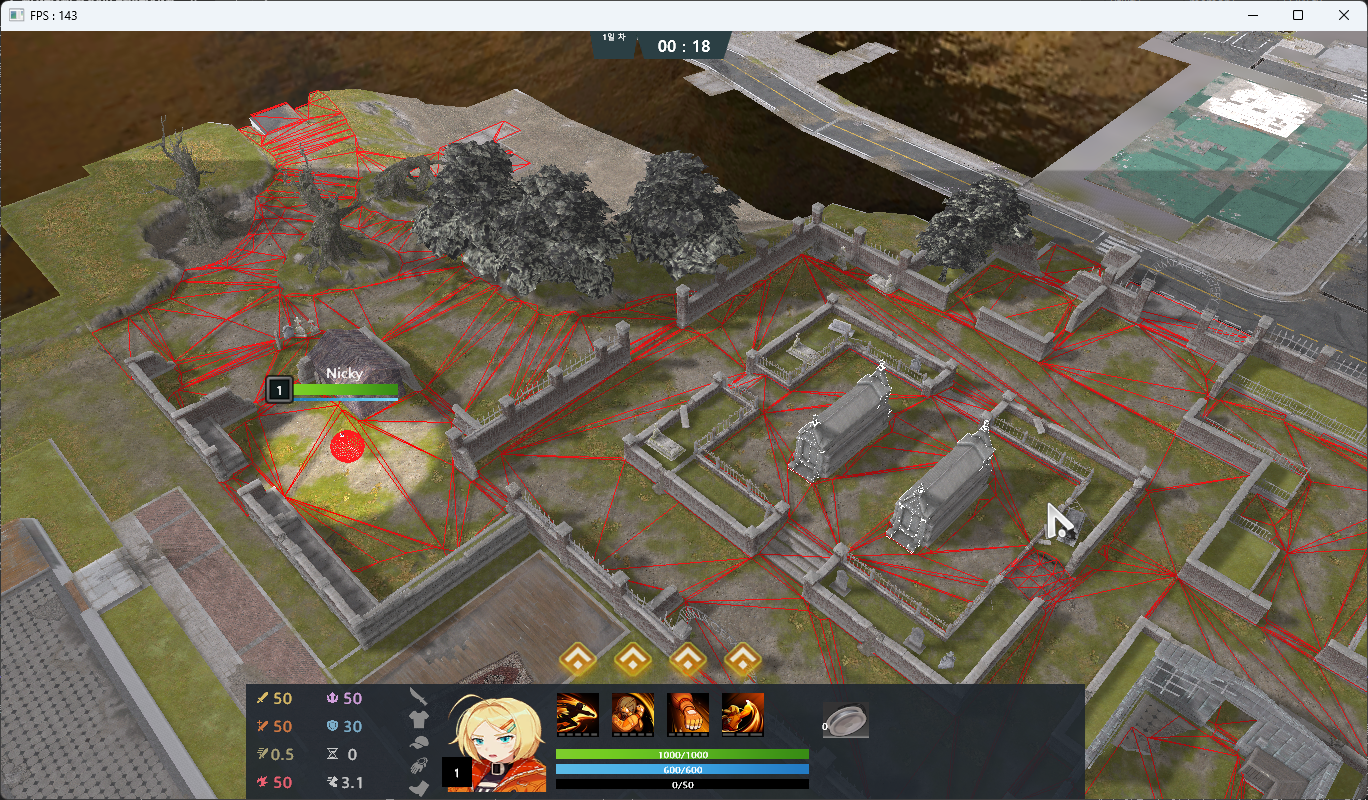
NavMesh는 게임 내 캐릭터들이 이동할 수 있는 영역을 삼각형 메시로 표현한 데이터 구조다. 각 삼각형은 이동 가능한 평면을 나타내며, 인접한 삼각형들을 연결하여 전체 이동 가능 영역을 구성한다.
NavMeshAgent란?
NavMeshAgent는 NavMesh 위에서 자동으로 경로를 찾아 이동하는 컴포넌트다. 목적지를 설정하면 A* 알고리즘을 통해 최적 경로를 계산하여 이동한다.
2. NavMesh 시스템 구조
2.1 삼각형 기반 NavMesh 구조
struct NavMeshTriangle
{
    Vec3 vertices[3];
    Vec3 center;
    Vec3 normal;
    vector<int> neighbors;
    int index = -1;
    AABB bounds;
};

struct PathNode
{
    int triangleIndex = -1;
    Vec3 position;
    float gCost = 0.0f;
    float hCost = 0.0f;
    float fCost = 0.0f;
    int parent = -1;

    bool operator<(const PathNode& other) const {
        return fCost > other.fCost;
    }
};
특징
- 삼각형 기반 표현 : 복잡한 지형도 모델링
- 인접성 그래프 : 각 삼각형이 연결된 이웃 삼각형 정보 보유
- 법선 벡터 저장 : 경사면 판단 및 투영 계산 최적화
NavMesh는 삼각형 기반의 네비게이션 메쉬로 구성된다. 각 삼각형은 인접한 삼각형들과의 연결 정보를 가지고 있어 경로 탐색이 가능하다.
2.2 메시 파일 기반 NavMesh 로딩
void NavMesh::LoadNavMeshData()
{
    // 기존 3D 모델 파일에서 NavMesh 데이터 추출
    auto modelRenderer = gameObject->GetModelRenderer();
    m_navMeshModel = modelRenderer->GetModel();

    const auto& meshes = m_navMeshModel->GetMeshes();
    auto transform = gameObject->GetTransform();
    Matrix worldMatrix = transform->GetWorldMatrix();

    // 각 메시에서 삼각형 데이터 추출 및 월드 좌표 변환
    for (size_t i = 0; i + 2 < indices.size(); i += 3)
    {
        NavMeshTriangle triangle;
        // 월드 좌표로 변환하여 삼각형 생성
        for (int j = 0; j < 3; j++)
        {
            Vec4 worldPos = XMVector4Transform(localPos, worldMatrix);
            triangle.vertices[j] = Vec3(worldPos.x, worldPos.y, worldPos.z);
        }
        // 삼각형 유효성 검사 및 법선 벡터 계산
        triangle.normal = edge1.Cross(edge2).Normalize();
        triangle.center = (triangle.vertices[0] + triangle.vertices[1] + triangle.vertices[2]) / 3.0f;
    }
}
특징
- 별도 NavMesh 제작은 하지 않고 기존 저장된 파일을 불러와서 사용
- 월드 변환 : Transform Matrix를 통한 좌표 변환
2. 성능 최적화
2.1 공간 분할 최적화 (Spatial Grid)
struct SpatialGrid {
    float cellsize = 25.f;
    unordered_map<uint64, vector<int>> grid;

    uint64 GetKey(const Vec3& pos) const {
        int x = static_cast<int>(pos.x / cellsize);
        int z = static_cast<int>(pos.z / cellsize);
        return (static_cast<uint64>(x) << 32) | static_cast<uint64>(z);
    }

    void AddTriangle(int idx, const NavMeshTriangle& tri) {
        // 삼각형이 겹치는 모든 그리드 셀에 인덱스 추가
        for (int x = minX; x <= maxX; x++) {
            for (int z = minZ; z <= maxZ; z++) {
                uint64_t key = (static_cast<uint64_t>(x) << 32) | static_cast<uint64_t>(z);
                grid[key].emplace_back(idx);
            }
        }
    }
};
최적화 효과
- O(n) -> O(1) 검색 : 전체 삼각형 순회 대신 해당 그리드 셀만 검색
- 비트 쉬프트 해상 : 빠른 2D좌표 -> 1D 키 변환
- 메모리 효율성 : 필요한 셀에만 데이터 저장
2.2 캐싱 기반 삼각형 탐색
int NavMesh::FindTriangleContaining(const Vec3& point)
{
    // 1단계: 이전 검색 결과 캐시 활용
    if (m_lastFoundTriangle != -1 && IsPointInTriangle(point, m_triangles[m_lastFoundTriangle])) {
        return m_lastFoundTriangle;
    }

    // 2단계: 인접 삼각형 우선 탐색 (지역성 원리)
    if (m_lastFoundTriangle != -1) {
        for (int neighbor : m_triangles[m_lastFoundTriangle].neighbors) {
            if (IsPointInTriangle(point, m_triangles[neighbor])) {
                m_lastFoundTriangle = neighbor;
                return neighbor;
            }
        }
    }

    // 3단계: 공간 그리드 기반 탐색
    uint64 key = m_spatialGrid.GetKey(point);
    auto it = m_spatialGrid.grid.find(key);
    // ...
}
최적화 효과
- 3단계 탐색 전략 : 캐시 -> 인접 -> 그리드 순서로 최적화
- 지역성 활용 : 연속된 위치 검색에서 높은 적중률
- 조기 종료 : 각 단계에서 찾으면 즉시 반환
3. A* 경로 탐색 알고리즘
3.1 삼각형 기반 A* 구현
bool NavMesh::FindTrianglePath(int startTriangle, int endTriangle, vector<int>& outPath)
{
    priority_queue<PathNode> openList;
    vector<bool> closedList(m_triangles.size(), false);
    vector<PathNode> allNodes(m_triangles.size());

    // A* 알고리즘 핵심: F = G + H
    PathNode startNode;
    startNode.gCost = 0;  // 시작점부터의 실제 비용
    startNode.hCost = GetDistance(m_triangles[startTriangle].center,
                                  m_triangles[endTriangle].center);  // 휴리스틱
    startNode.fCost = startNode.gCost + startNode.hCost;  // 총 예상 비용

    while (!openList.empty())
    {
        PathNode currentNode = openList.top();
        openList.pop();

        // 목적지 도달 체크
        if (currentNode.triangleIndex == endTriangle) {
            ReconstructPath(allNodes, endTriangle, outPath);
            return true;
        }

        // 인접 삼각형들 탐색
        for (int neighborIndex : m_triangles[currentNode.triangleIndex].neighbors)
        {
            float tentativeGCost = currentNode.gCost +
                GetDistance(m_triangles[currentNode.triangleIndex].center,
                           m_triangles[neighborIndex].center);

            // 더 나은 경로 발견시 업데이트
            if (tentativeGCost < allNodes[neighborIndex].gCost) {
                // 노드 정보 갱신 및 오픈리스트 추가
            }
        }
    }
}
A* 알고리즘 최적화
- 휴리스틱 함수 : 유클리드 거리 기반 예상 비용 계산
- 우선순위 큐 : F값이 낮은 노드 우선 탐색
- 경로 복원 : 부모 노드 추적으로 최종 경로 구성
3.2 경로 스무딩 최적화
void NavMesh::SmoothPath(const vector<Vec3>& originalPath, vector<Vec3>& outPath)
{
    outPath.reserve(originalPath.size());
    outPath.push_back(originalPath[0]);

    size_t cur = 0;
    while (cur + 1 < originalPath.size())
    {
        int bestNext = cur + 1;
        bool foundValidPath = false;

        // 시야선(Line of Sight) 기반 최적화
        for (size_t i = cur + 1; i < originalPath.size(); ++i)
        {
            if (HasLineOfSight(outPath.back(), originalPath[i])) {
                bestNext = static_cast<int>(i);
                foundValidPath = true;
            }
        }

        // NavMesh 경계 검사
        if (!foundValidPath && !IsLineOnNavMesh(outPath.back(), originalPath[bestNext]))
        {
            Vec3 safe = GetNearestPointOnNavMesh(originalPath[bestNext]);
            outPath.push_back(safe);
        }
        else {
            outPath.push_back(originalPath[bestNext]);
        }
        cur = bestNext;
    }
}
스무딩 기법
- 시야선 검사 : 직선 경로 가능성 판단
- 웨이포인트 생략 : 불필요한 중간점 제거
- 안전성 보장 : NavMesh 경계 이탈 방지
동영상 서비스가 종료되어 해당 콘텐츠를 재생할 수 없습니다.
완벽하게 이동이 구현이 되지는 않았다. 일부 경로에서 벽에 가로막혀 못가는 현상이 종종 있다.
4. NavMeshAgent 이동 시스템
4.1 Agent 컴포넌트
class NavMeshAgent : public Component
{
private:
    shared_ptr<NavMesh> m_navMesh;
    vector<Vec3> m_path;
    uint32 m_currentPathIndex = 0;
    Vec3 m_destination;
    NavMeshAgentState m_state = NavMeshAgentState::Idle;

    float m_speed = 5.0f;
    float m_stoppingDistance = 0.1f;

public:
    void SetDestination(const Vec3& destination);
    void UpdateMovement();
    bool HasReachedDestination() const { return m_state == NavMeshAgentState::Arrived; }
};
4.2 부드러운 이동 구현
void NavMeshAgent::UpdateMovement()
{
    if (m_path.empty() || m_currentPathIndex >= m_path.size())
    {
        m_state = NavMeshAgentState::Arrived;
        return;
    }

    auto transform = GetTransform();
    if (!transform) return;

    Vec3 currentPos = transform->GetPosition();
    Vec3 targetPos = m_path[m_currentPathIndex];
    float distance = Vec3::Distance(currentPos, targetPos);

    // 현재 웨이포인트에 도달했으면 다음으로
    if (distance <= m_stoppingDistance)
    {
        m_currentPathIndex++;
        if (m_currentPathIndex >= m_path.size())
        {
            m_state = NavMeshAgentState::Arrived;
            return;
        }
        targetPos = m_path[m_currentPathIndex];
    }

    // 이동 처리
    Vec3 direction = targetPos - currentPos;
    direction.y = 0; // Y축 고정

    if (direction.Length() > 0.01f)
    {
        direction.Normalize();

        // 회전 계산 및 적용
        float targetYaw = atan2(direction.x, direction.z) + 3.141592f;
        Vec3 currentRotation = transform->GetLocalRotation();
        Vec3 newRotation = Vec3(currentRotation.x, targetYaw * 180.0f / 3.14159f, currentRotation.z);
        transform->SetLocalRotation(newRotation);

        // 위치 업데이트
        Vec3 newPos = currentPos + direction * m_speed * DT * 2.5f;
        if (m_navMesh)
        {
            newPos = m_navMesh->GetNearestPointOnNavMesh(newPos);
        }
        transform->SetPosition(newPos);
    }
}
5. State Machine과의 통합
5.1 Monster AI 에서의 활용
void MonsterStateMachine::ProcessAI()
{
    switch (currentState)
    {
    case MonsterStateType::Trace:
        if (hasValidTarget && distanceToTarget <= m_attackRange)
        {
            // 공격 사거리 진입시 NavMeshAgent 정지
            RequestStateChange(MonsterStateType::Attack);
        }
        break;

    case MonsterStateType::Attack:
        if (distanceToTarget > m_attackRange)
        {
            // 타겟이 멀어지면 다시 추적
            RequestStateChange(MonsterStateType::Trace);
        }
        break;
    }
}

void NavMeshAgent::SetDestination(const Vec3& destination)
{
    Vec3 startPos = transform->GetPosition();
    Vec3 targetPos = m_navMesh->GetNearestPointOnNavMesh(destination);

    // A* 경로 계산
    m_navMesh->FindPath(startPos, targetPos, m_path);
    m_destination = targetPos;
    m_state = NavMeshAgentState::Moving;
}
5.2 Player입력 처리에서의 활용
void PlayerStateMachine::HandleMovementInput()
{
    if (m_navMeshAgent)
    {
        POINT mousePos = INPUT->GetMousePos();
        Ray ray = CreateRayFromMouse(mousePos, cameraComp);

        // NavMesh와의 Ray 교차 검사
        for (auto& obj : CURSCENE->GetObjects())
        {
            auto navMesh = obj->GetFixedComponent<NavMesh>(ComponentType::NavMesh);
            if (navMesh)
            {
                Vec3 hitPoint;
                if (navMesh->RaycastNavMesh(ray, hitPoint))
                {
                    // 유효한 목적지 설정
                    GetGameObject()->GetNavMeshAgent()->SetDestination(hitPoint);
                    RequestStateChange(PlayerStateType::Run);
                    break;
                }
            }
        }
    }
}
6. 추격 및 공격 패턴
6.1 알파 몬스터 추격 시스템
class AlphaTrace : public MonsterBehaviour
{
private:
    float m_traceSpeed = 2.0f;
    float m_attackRange = 3.f;
    float m_pathUpdateInterval = 0.5f;
    float m_updateTimer = 0.0f;

public:
    void Update() override
    {
        if (!m_target || !m_owner || !m_navAgent)
            return;

        Vec3 otherObjPos = m_target->GetTransform()->GetPosition();
        Vec3 wolfPos = m_owner->GetTransform()->GetPosition();

        CalcDir(otherObjPos, wolfPos);

        m_updateTimer += DT;
        if (m_updateTimer >= m_pathUpdateInterval)
        {
            m_navAgent->SetDestination(m_target->GetTransform()->GetPosition());
            m_navAgent->SetSpeed(m_traceSpeed);
            m_updateTimer = 0.0f;
        }
    }

    void CalcDir(Vec3 otherPos, Vec3 wolfPos)
    {
        Vec3 dir = otherPos - wolfPos;
        dir.Normalize();

        // 회전 계산 및 적용
        float targetYaw = atan2(dir.x, dir.z) + 3.141592f;
        Vec3 currentRotation = m_owner->GetTransform()->GetLocalRotation();
        Vec3 newRotation = Vec3(currentRotation.x, (targetYaw * 180.0f / 3.14159f), currentRotation.z);

        m_owner->GetTransform()->SetLocalRotation(newRotation);
    }
};
6.2 공격 패턴 구현
class AlphaBaseAttack : public MonsterBehaviour
{
private:
    bool m_isAttacking = false;
    bool m_isAttackComplete = false;
    float m_attackTimer = 0.f;
    float m_attackDuration = (36.f / 25.f);
    float m_attackRange = 1.2f;
    float m_skillCoolTime = 0.f;

public:
    void Update() override
    {
        if (!m_isAttacking || !m_target || !m_owner)
            return;

        Vec3 otherObjPos = m_target->GetTransform()->GetPosition();
        Vec3 wolfPos = m_owner->GetTransform()->GetPosition();

        CalcDir(otherObjPos, wolfPos);

        // 공격 타이머 갱신
        m_attackTimer += DT;
        m_skillCoolTime -= DT;
        float distance = Vec3::Distance(wolfPos, otherObjPos);

        if (!m_isAttackComplete && m_attackTimer >= m_attackDuration)
        {
            m_attackTimer = 0.f;

            // 스킬 쿨다운 체크
            if (m_skillCoolTime <= 0)
            {
                static_pointer_cast<Alpha>(m_owner)->PlaySkill(m_target);
                m_skillCoolTime = 12.5f;
            }

            // 플레이어에게 데미지 적용
            static_pointer_cast<Player>(m_target)->Damaged(
                static_pointer_cast<Monster>(m_owner),
                static_pointer_cast<Monster>(m_owner)->GetMonsterStatus().adPower
            );
        }
    }
};
7. 성능 최적화 기법
7.1 계층적 경로 탐색
void NavMesh::ConvertTrianglePathToWorldPath(const vector<int>& trianglePath,
                                           const Vec3& start, const Vec3& end,
                                           vector<Vec3>& outPath)
{
    outPath.clear();
    if (trianglePath.empty()) return;

    // 예상 크기로 메모리 미리 할당
    outPath.reserve(trianglePath.size() + 1);

    outPath.push_back(start);

    for (size_t i = 1; i < trianglePath.size() - 1; i++)
    {
        outPath.push_back(m_triangles[trianglePath[i]].center);
    }

    outPath.push_back(end);
}
결론
- 삼각형 기반 정밀 내비게이션
- 복잡한 3D 지형의 정확한 표현
- 인접성 그래프를 통한 효율적인 경로 탐색
- 법선 벡터 기반 지형 특성 파악
- 다단계 성능 최적화
- 공간 분할 : O(n) -> O(1) 삼각형 검색 최적화
- 캐싱 전략 : 지역성 기반 빠른 삼각형 탐색
- 메모리 최적화 : 참조 기반 매개 변수로 불필요한 복사 제거
- 고급 A* 구현
- 삼각형 중심점 기반 노드 그래프
- 유클리드 거리 휴리스틱으로 최적 경로 보장
- 우선순퀴 큐 기반 효율적인 탐색
- 지능형 경로 스무딩
- 시아선 검사로 불필요한 웨이포인트 제거
- NavMesh 경계 준수로 안전성 보장
- 적응형 샘플링으로 성능과 정확도 균형
- 상태 기계 통합
- 이벤트 기반 상태 전환으로 반응성 향상
- AI와 플레이어 입력 모두 지원
'DirectX11 > Eternal Return 모작' 카테고리의 다른 글
| [DirectX 11 Eternal Return 모작] 14. UI (0) | 2025.09.03 |
|---|---|
| [DirectX 11 Eternal Return 모작] 13. 전투 , 데미지 시스템 (0) | 2025.09.03 |
| [DirectX 11 Eternal Return 모작] 11. 스킬 시스템 (0) | 2025.09.03 |
| [DirectX 11 Eternal Return 모작] 10. 인벤토리와 장비 시스템 (0) | 2025.09.03 |
| [DirectX 11 Eternal Return 모작] 9. 아이템 시스템 & 제작 시스템 (0) | 2025.09.03 |